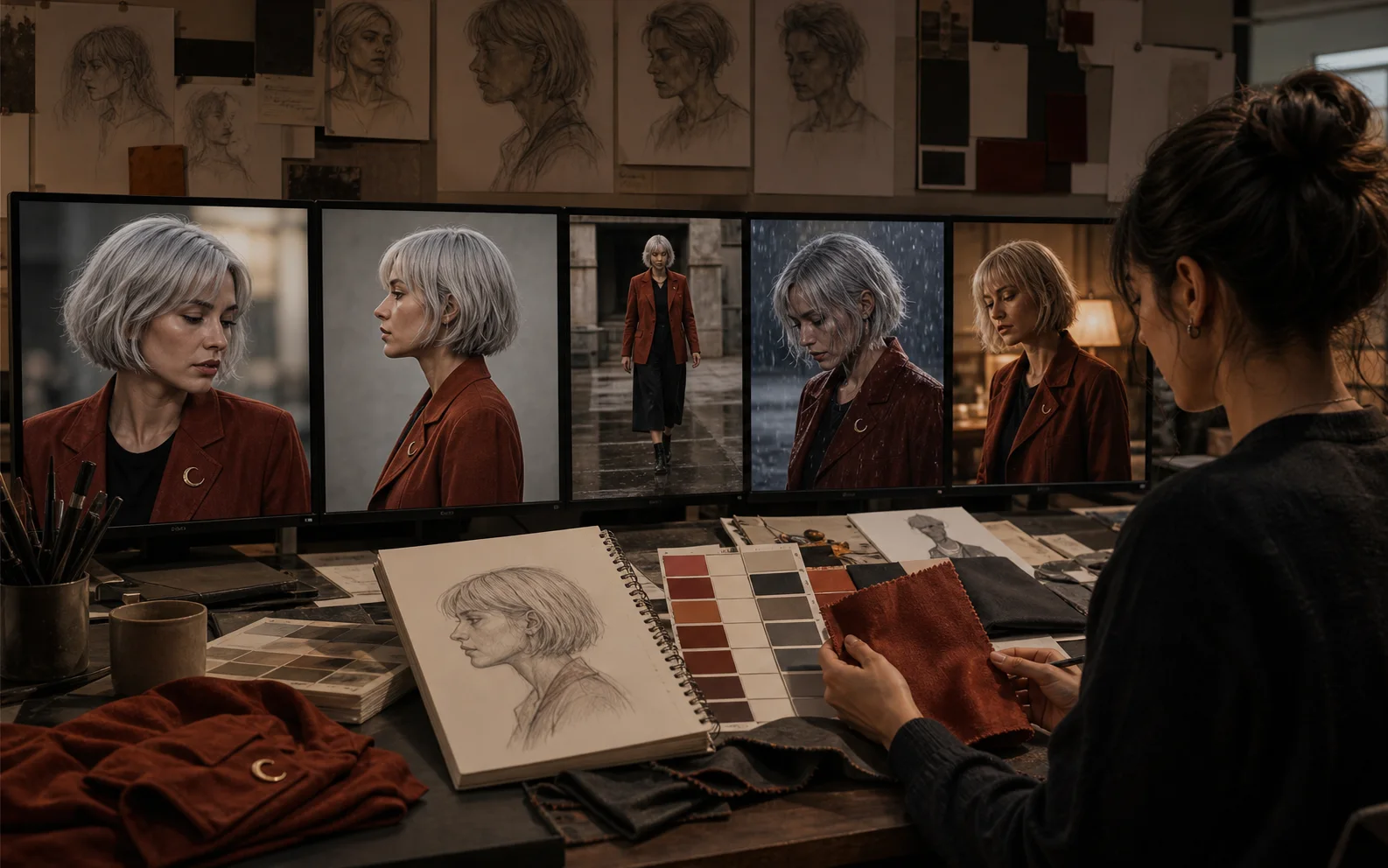
Create a compact reference pack, lock identity anchors, reduce simultaneous changes, and review every shot against a continuity ledger before it enters the edit.
Build a reference pack before generating scenes
Use a small set of clear images rather than a large inconsistent mood board. Include a neutral face, profile or three-quarter view, full body, expression range, and the primary wardrobe under simple lighting.
Write three to five identity anchors that should survive every shot. These might be face shape, hair silhouette, a distinctive garment, age range, or a specific accessory. Avoid long adjective chains that introduce competing interpretations.
Keep a continuity ledger
The ledger records what is true in each scene: wardrobe, hair, props, injuries, time of day, screen direction, environment, and emotional state. Add an approved reference frame for every major change.
This is not bureaucracy. It prevents a later shot from using the wrong version of the character and avoids trying to repair continuity after animation.
Change fewer variables at once
Identity drift increases when a shot simultaneously changes camera angle, lighting, expression, wardrobe, environment, and action. Prove the character in a simple shot, then introduce complexity in stages.
A useful order is:
- Neutral medium shot
- New expression with stable camera
- New camera angle with stable wardrobe
- Simple body action
- Environment and lighting variation
- Complex movement or interaction
If consistency breaks, this sequence reveals which change caused it.
Design cuts that support continuity
Not every transition needs to expose the character continuously. Inserts, over-the-shoulder frames, silhouettes, reaction shots, and environmental details can carry story information while reducing identity pressure.
Use motion direction and eyelines to connect shots even when the camera changes. Viewers tolerate small visual variation more readily when editing grammar remains coherent.
Separate identity from style
Generate or approve the character in a neutral style before applying aggressive stylization. If identity and style are established at the same time, it becomes difficult to know whether a failed shot is a reference problem or a style problem.
For video-to-video work, preserve facial landmarks and silhouette before pushing texture, color, or medium transformation.
Review with an acceptance checklist
Do not approve a shot because the first frame looks right. Scrub the entire duration and check:
- Face and hair silhouette
- Apparent age and body proportions
- Wardrobe and accessory placement
- Hands during interaction
- Eye color and gaze direction
- Lighting continuity at edit points
- Identity stability during fast motion
Compare against the previous and next shot, not only the original reference.
Know when to regenerate
Regenerate when identity changes during a story-critical close-up, the drift affects meaning, or repair would create more artifacts. Hide or repair minor variation when it occurs briefly, away from attention, and does not change recognition.
The production goal is not mathematical sameness. It is stable recognition across the sequence at the viewing speed and screen size that matter.
Questions creators ask
Why do AI video characters change between shots?
Models must infer identity again from prompts and references while pose, lighting, angle, and motion also change. Weak references and too many simultaneous changes increase drift.
What belongs in a character reference pack?
Include a neutral front view, profile or three-quarter view, full-body image, expression range, wardrobe details, and a short list of identity anchors.
Can prompts alone maintain character consistency?
Prompts help, but visual references, controlled shot design, and a continuity review are generally more reliable than repeating descriptive adjectives.
Built from production practice, primary product documentation, and repeatable workflow checks. Read our editorial standards.